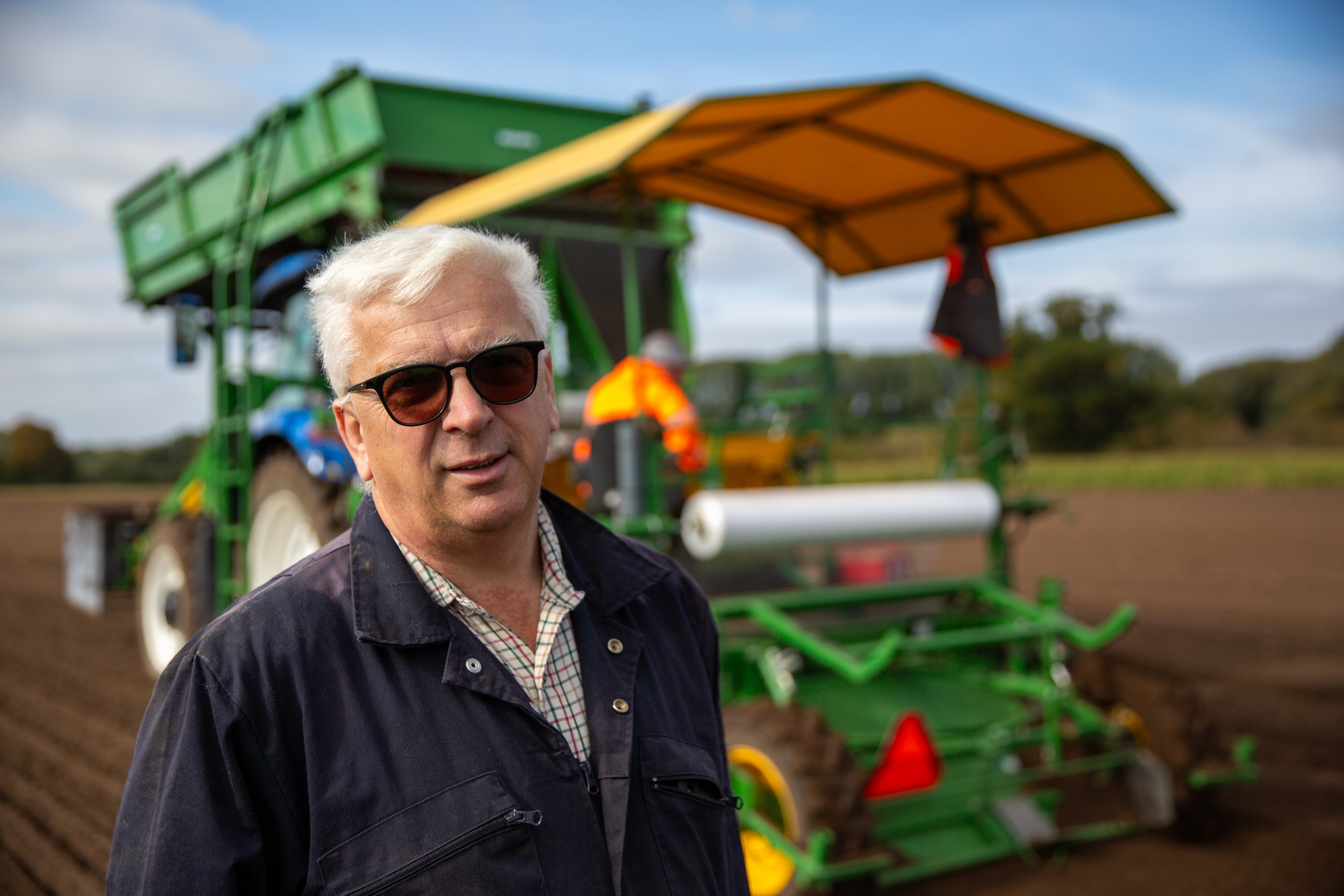
“I’m Mark Eves. Director at PS and JE Ward Limited and in charge of growing all the tulip bulbs we sell. We sell flowers to a lot of the main supermarkets as well as exporting a lot of our bulbs to Holland, but other countries as well. Plus, we want to use our blooms in the fields to maximise fund raising for a local hospice charity.”
“We’re probably producing 20-25 million bulbs over about 100 acres. We plant in October ideally. They flower in April-early May. We take all the heads off and harvest in June-July. We sort them in August and we plant them in November-December for 20 weeks’ growth in glasshouse to sell as flowers.”
“We cannot return to a field more than one year in ten. One in seven is acceptable but I’d rather go back only one in 10 or 12 or never. Why? Because if we drop a bulb and come back in 3 years that bulb is surviving and we’ll have wrong bulbs in the wrong stock. Having fresh fields each year lowers disease pressures and also our inputs, reducing our carbon footprint.
“When we started, we were on 60-inch rows, 60-inch wheel centres, but we’ve got a new planting machine going out wider to 72.
“The tulips are grown in nets. In the ground there’s two layers of net. One under the bulb and one over it. We are always looking for ways to reduce challenges of pests and diseases. Like potatoes, they are vulnerable to viruses.
 Tulip bulbs are planted in nets to reduce pest & disease challenges
“The varieties are ever evolving and changing enabling us to give cut tulip flower customers a three or four colour mix (yellow, red, purple and multi-coloured) for the whole 20-week season. Plus, we have moved into selling our bulbs online.
“We are scaling up the number of people we aim to attract to the tulips fields when in bloom to raise more money for our chosen charity Tapping House hospice.”
“In the first year of opening to visitors to raise money for charity we reached £22,000. In 2025 we raised £507,450! We had 31,000 visitors to our fields of 9.3 million tulips for the two five-day blocks we were open. We had a ticketing system online. We make a lot of money with a little bit of help from every single one of a huge number of people, about 250 volunteers, who together give about 5,000 volunteer hours to our event. Every bit of money raised helps people with life-changing illness so they can live well for as long as possible and their family is supported too. They also help people with disabilities to cope and prosper.
“You’d be amazed at how much more efficient we are from expanding the row spacing, reducing the diesel used and the manpower."
"Lifting the nets at harvest, there’s pretty much just bulbs, no stones and not much soil. We’re having to use chemistry with less environmental impact, and that probably costs more and needs more frequent applications.
“For the online bulb sales, we’re slowly feeling our way into it. We did it as a pre-order service, that’s what the visitors to the fields have asked us for. And it’s worked really well. We want to make a good job of it, so we don’t make silly mistakes. I’m big believer that you must never over promise!”
“We’ve been with AF since 2007. It works well. AF is like a backbone for our business. A central resource we can consult, ask questions and get help from. It’s such a help to have someone at the end of a phone we speak to. If we’re not sure about a purchase, or something we want to get hold of, AF can give us advice and source what we need. We keep an eye on everything and if we’re not happy, we tell you.”
“We’re looking at the whole business structure. Obviously, the inheritance tax issue is influencing a lot of people. We’re looking to learn and seek advice on what’s best to do.”
Visit www.norfolktulips.co.uk for more details about tulips or www.tappinghouse.org.uk to find out about the work they do.
Ready to find out how much AF could save your farming or rural business? Use our Savings Calculator.